
QUESTION: Why shouldn’t ETF & fund research be as good as stock research? Why should fund investors rely on backward-looking price trends?
ANSWER: They should not.
QUESTION: Why has the traditional, backward-looking fund research dominated the dialogue on funds for so long?
ANSWER: Purveyors of the traditional fund research are extremely good marketers.
QUESTION: How exactly should fund research change to be more like stock research?
ANSWER: A fund is only as good as the stocks it holds. To rate a fund, one must research and rate all of its holdings while also accounting for management costs.
There are two drivers of future fund performance:
- Stock-picking (Portfolio Management Rating) and
- Fund expenses (Total Annual Costs Rating)
Our Predictive Overall Fund Rating is based on these drivers. Then, we rate all funds based on their ranking:
- Top 10% = Very Attractive Rating
- Next 20% = Attractive Rating
- Next 40% = Neutral Rating
- Next 20% = Unattractive Rating
- Bottom 10% = Very Unattractive Rating
We analyze every fund holding based on New Constructs’ stock ratings, which are regularly featured as #1 by SumZero (details here). And, Harvard Business School proves our Stock Ratings outperform Wall Street stock ratings (details here).
Next, we measure and rank the all-in costs of investing in a fund (Total Annual Costs Rating).
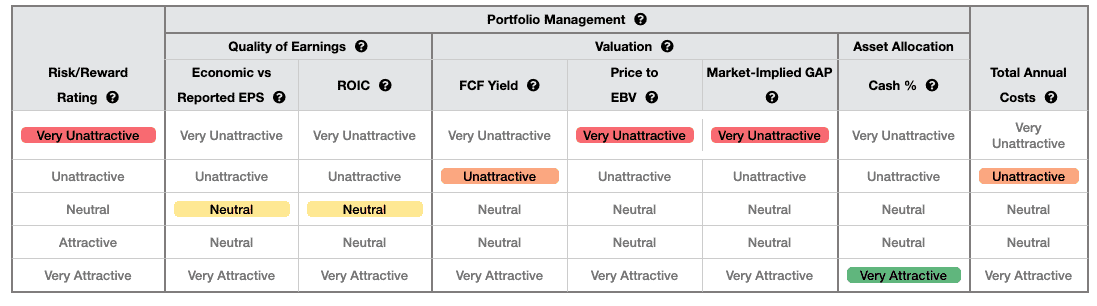
Figure 1 details the criteria that drive our predictive rating system for funds. The two drivers of our predictive fund rating system are Portfolio Management and Total Annual Costs. The Portfolio Management Rating (details here) is the same as our Stock Rating (details here) except that we incorporate Asset Allocation (details here) in the Portfolio Management Rating. The Total Annual Costs Rating (details here) captures the all-in cost of being in a fund over a 3-yr holding period, the average holding period of all mutual fund investors.
Figure 1 – Predictive Overall Fund Rating Criteria and Thresholds for US Equity Funds
Source: New Constructs, LLC
6 replies to "“Predictive” ETF & Mutual Fund Rating Methodology"
It’s too bad you guys don’t weigh performance. I checked the best-performing funds against your index, which had them ranked low due to their higher fees.
As an investor, I’m ok with higher fees if the performance warrants it. Your rating model doesn’t seem to account for overperformance.
In fact your top rated funds are actually very poor performers against their peers.
Mike S:
Past performance is no guarantee of future performance. A mutual fund that performed well last year could easily perform poorly this year. I rate funds based on the quality of their holdings, as the holdings are what drive the performance of the fund.
Higher fees are acceptable if the performance warrants it. Several of my Attractive-rated funds have above average fees, but the quality of their holdings outweighs their higher fees. However, my highest rated funds are those that combine high quality holdings with low costs.
Thanks for your comment,
David Trainer
Interesting take on mutual funds and I like the idea, and wondering if you’ve looked at some period of future performance of funds you’ve ranked highly (mos/yrs) to see if your theory is predictive in some way.
While I agree with the idea that funds should perform in line with their holdings overall, it’s hard to believe that 95% of stocks in the funds with low cost are unattractive or neutral, but perhaps the implication is correct that just over half of funds don’t perform well.
Seems to require further analysis.
Scott:
We have not measured the performance of our ETF/fund picks yet.
However, we do measure the performance of our stock ratings, and they do very well.
Given that the fund ratings are primarily a function of the stock ratings of their holdings, I think it safe to assume the fund ratings perform consistently with the stock ratings.
Looking at the etf list, I fail to understand what is going on. You say you look at the portfolio holdings of the listed funds. But there are so many cases of etf’s listed right next to each other when the only thing they have in common is the fund sponsor and the expense ratio.
An example from August 31, 2013…
211 FEX First Trust Large Cap Core AlphaDEX Fund ETF Large Cap Blend $502 0.78% Buy
212 FXD First Trust Consumer Discretionary AlphaDEX Fund ETF Consumer Discretionary $739 0.78% Buy
213 FAB First Trust Multi Cap Value AlphaDEX Fund ETF All Cap Value $89 0.78% Buy
214 FAD First Trust Multi Cap Growth AlphaDEX Fund ETF All Cap Growth $37 0.78% Buy
215 FNK First Trust Mid Cap Value AlphaDEX Fund ETF Mid Cap Value $21 0.78% Buy
216 FXR First Trust Industrials/Producer Durables AlphaDEX Fund ETF Industrials $236 0.78% Buy
217 FXH First Trust Health Care AlphaDEX ETF Health Care $1,023 0.78% Buy
Please explain.
Douglas:
Thanks for reading and commenting. My portfolio ratings are based on my ratings of all the stocks held by a given ETF. Two ETFs with different sector/style focuses and different holdings can still get a similar rating.
For instance, even though FXD and FAB don’t have much overlap, their holdings earn similar ratings. FXD allocates 27% of its assets to Attractive-or-better rated stocks and 30% in Dangerous-or-Worse stocks. FAB allocates 23% of its assets to Attractive-or-better rated stocks and 35% to Dangerous-or-worse.
These ETFs don’t have much in common, but the overall quality of their holdings is similar and their fees are the same.